
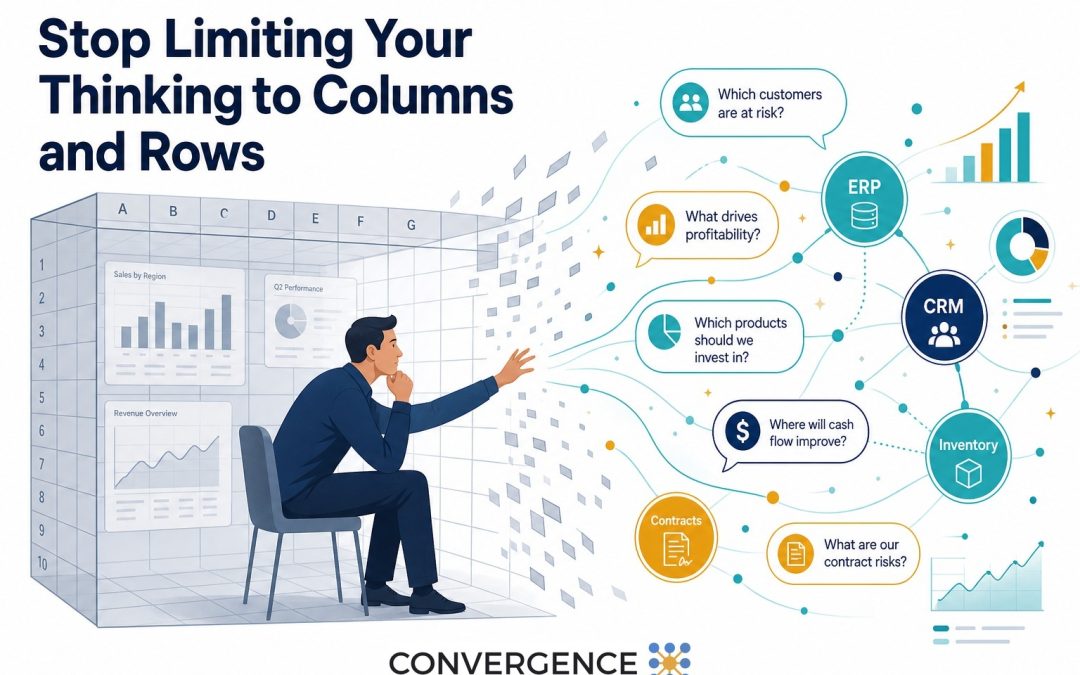
Stop Limiting Your Thinking to Columns and Rows
By Mark Presnell, Managing Director, Convergence Limited
The Box You Didn’t Know Your Thinking Is In
I want to ask you something before we get into this.
When was the last time you asked your business a question — and got an answer that surprised you?
Not a report you already expected. Not a dashboard that confirmed what you thought you knew. A genuine answer to a question you hadn’t thought to ask before.
If you’re struggling to remember, you’re not alone. And it’s not because your business doesn’t hold that kind of insight. It’s because the tools we’ve been using to analyse business data for the last thirty years have quietly trained us to only ask questions they can already answer.
Think about it. Every spreadsheet, every BI dashboard, every management report is built around a structure someone defined in advance. Columns. Rows. Filters. Segments. The data you can see is the data someone chose to show you — organised into categories someone decided mattered.
That structure is enormously useful. But it comes with a hidden cost: it narrows your thinking to fit the shape of the tool.
Over time, you stop asking questions that the tool can’t answer. Not consciously. You just… stop. The question never forms, because somewhere in your experience you’ve learned — without ever being told — that the data doesn’t work that way.
This is the box. And most business owners are in it without knowing it.
The tell-tale signs are subtle:
— You make decisions based on the reports you have, not the questions you wish you could answer.
— When you want to know something specific, someone has to “pull the data” — which means building a new view, exporting files, or cross-referencing spreadsheets manually.
— The most valuable insights in your business live at the intersection of multiple data sources: sales, inventory, customer behaviour, contracts, external conditions — and you have no clean way to query across all of them at once.
— You’ve normalised not knowing things it would be entirely reasonable to know.
None of this is a failure of intelligence or ambition. It is a failure of infrastructure. The tools set the boundary, and the boundary became the habit.
What CODI Private AI changes isn’t just the speed or the convenience of data access. It changes the shape of the question you’re allowed to ask.
Your ERP, CRM, eCommerce platform, inventory system, accounting software, customer contracts — when these are fully integrated and available to a private AI model running on your own infrastructure, the column-and-row constraint disappears. You can ask questions that span every data source simultaneously, in plain English, without building a report, without waiting for someone to pull the data, and without any of that data leaving your network.
The constraint was never the data. It was always the interface.
New Thinking, Entirely New Questions
The shift that CODI Private AI makes possible isn’t just faster reporting. It’s a different category of question entirely — questions that cut across sales, customers, inventory, contracts, seasonality, and external conditions all at once. Questions that no spreadsheet was ever built to answer, because they don’t live in any single column or row.
Consider this question:
“Which of our top 10 customers by revenue are showing declining order frequency, have an active contract with minimum purchase commitments, AND have a renewal due in the next 90 days — ranked by revenue at risk?”
Take a moment with that. To answer it today, someone in your business would need to pull revenue data from your ERP or accounting system, cross-reference it with order history from your eCommerce platform, locate the relevant contracts, check renewal dates, calculate the revenue exposure, and compile it into something readable. That is a project, not a query. It might take half a day. It might not happen at all.
With CODI Private AI — where your ERP, eCommerce platform, CRM, and contract data are all integrated and available to your private AI model — that question gets answered in seconds. In plain English. By anyone in your business who needs to know.
Now consider this one:
“Are there any customers whose order volumes, satisfaction signals, and contract renewal timing together suggest a churn risk we should be acting on right now?”
This one is harder still. It requires your AI to hold sales trends, support interaction history, satisfaction data, and contract timelines in view simultaneously — and make an intelligent inference about risk. Not just retrieve data, but reason across it.
That is what a properly integrated private AI can do. Not because it’s magic. Because the integration layer — CODI connecting every system in real time — gives it clean, complete, current data to reason from.
The point isn’t the technology. The point is the question.
When you can ask questions like these — and get reliable answers in seconds — the way you run your business changes. You stop reacting to what the report tells you and start acting on what you actually need to know.
Thinking in Outcomes, Not Columns
There is a practical framework that underpins all of this — and it is worth being deliberate about it, because the habit of column-and-row thinking runs deep.
Before you build a report, or ask your AI anything, start with three questions:
1. What decision am I trying to make — or what action am I trying to take?
2. What do I need to know to make that decision confidently?
3. Where does that information currently live — and is it connected?
Most business reporting starts with question three and works backwards. You start with the data you have, build a view of it, and then decide what it means. Outcome-first thinking starts with question one. You start with the decision, work out what you need to know, and then ask for it directly.
It sounds like a small shift. In practice, it changes everything you look at.
Here is what that looks like in practice:
“Heading into our peak season, which product lines are most likely to face fulfilment pressure — and do any of the customers likely to drive that demand have satisfaction issues we haven’t resolved yet?”
This question starts with a decision: how do we prepare for peak season without damaging key customer relationships? It pulls together seasonal ordering patterns, inventory positions, demand forecasting, and open customer satisfaction issues — simultaneously, in real time. No single system in your business holds all of this. But CODI, connecting your eCommerce, inventory, ERP, and CRM, does.
“Based on last year’s Q4 ordering patterns, which customers are likely to place large orders in the next 8 weeks — and do we have the stock position to fulfil them without risking the relationship?”
This is proactive relationship management, not reactive reporting. It lets you reach out to high-value customers before the pressure hits — armed with the information to have a genuinely useful conversation. That is not something a dashboard tells you. It is something an integrated private AI reasons toward.
The businesses that will pull ahead in the next three years won’t be the ones with the most data. They’ll be the ones that learned to ask the right questions — and built the infrastructure to answer them.
The Business That Asks Better Questions Wins
Most businesses competing in your market are making decisions the same way. Pulling reports. Waiting for someone to “get back to them with the numbers.” Normalising the gap between the question they have and the answer they can actually access.
That gap is where decisions get made with incomplete information. Where risks go unnoticed. Where opportunities are missed because nobody thought to look across the right combination of data at the right time.
Now consider what changes when one business in that competitive set can ask questions like these — and get reliable answers in seconds:
“Which of our customers operate in sectors facing incoming compliance changes in the next 12 months, have contracts that don’t yet reflect those obligations, and haven’t engaged with us in the last 60 days?”
This question spans legislation, contracts, and customer engagement simultaneously. It is a proactive risk management and retention question — and it’s one that most businesses simply cannot answer today without significant manual effort. The business that can ask it — and act on the answer — is having conversations with at-risk customers before their competitors even know there’s a risk.
“Show me every account where margin has declined over the last two quarters, cross-referenced with any open support issues, backorder events, or contract pricing terms set more than 18 months ago.”
This is a margin protection and relationship health question. It connects financial performance, operational friction, and commercial terms in a single view. The business that asks this question regularly doesn’t wait for a customer to walk — they see the conditions that lead to it, and act early.
The asymmetry is the point.
When one business in a market can ask and answer questions at this level of sophistication — in real time, across all their integrated data, on their own private infrastructure — and their competitors are still waiting for someone to pull a spreadsheet, the compounding effect becomes significant fast.
This is not a future scenario. The infrastructure exists today. CODI provides the integration foundation. CODI Private AI provides the natural language intelligence layer on top of it. The hardware — with NVIDIA’s RTX Spark coming to mainstream devices this autumn — is arriving at desks near you.
The question for every growing business is a straightforward one:
When your competitors make this shift — and some of them will — will you be ahead of it, or behind it?
Book a time to discuss your options here.
About the Author
Mark Presnell is Managing Director of Convergence Ltd, systems integration specialists since 1997. Convergence builds and manages integrations between eCommerce websites and backend business software through CODI — Convergence Optimised Data Integration — and offers Integration for Private AI for businesses who want to run their own private AI models on their own dedicated infrastructure. Book a free requirements assessment at convergence.co.nz.